Loading...
Serving Warner Robins, GA and surrounding areas. (478) 339-9317
If your slope is washing away after every storm or your yard is losing usable space to a steep drop, a properly built retaining wall stops the problem and gives you that ground back.
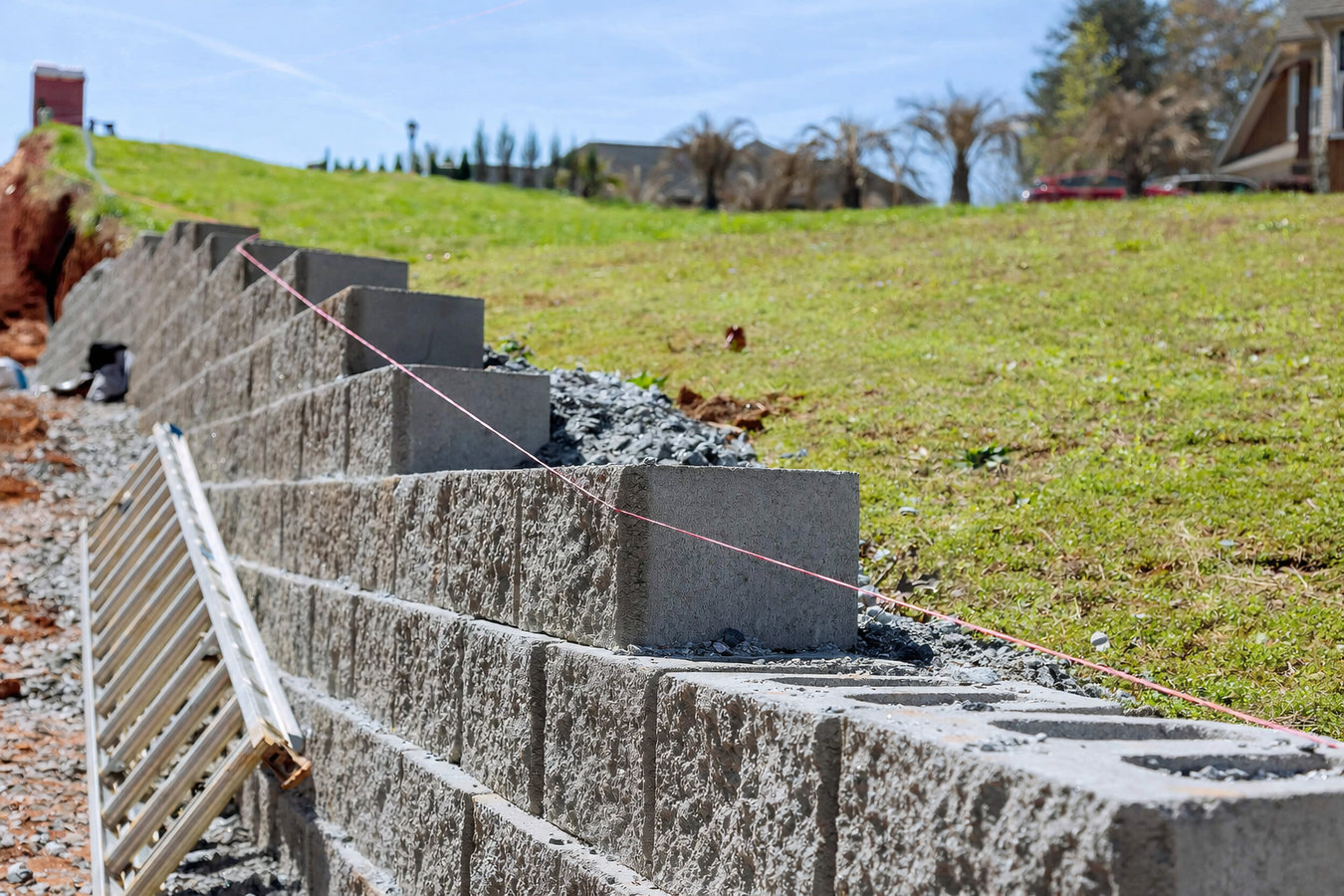
Retaining wall construction in Warner Robins holds back soil on a slope to prevent erosion and redirect water, built from concrete block, natural stone, or poured concrete on a compacted base with gravel backfill and drainage pipe, and most residential walls take one to three days once the permit is in hand.
The wall itself is only part of the job. In Warner Robins, the clay-heavy soil that covers most of Middle Georgia expands when it absorbs water and shrinks when it dries out. That movement creates pressure behind any wall, and a wall built without a proper drainage system to relieve that pressure will eventually crack or lean - often within a few years. Getting the drainage right is what separates a wall that holds for 50 years from one that needs rebuilding after a handful of bad summers.
If your slope is near an existing structure, we may recommend pairing the wall with masonry restoration or surface repairs on nearby concrete to address the full picture at once.
Bare patches appearing on a slope after a heavy rain, or mud collecting at the bottom of your yard, means your soil is eroding. Warner Robins gets intense summer storms that can strip unprotected slopes quickly, and once erosion starts it tends to get worse each season until the slope is stabilized.
If water from a sloped area runs toward your foundation, garage, or driveway during rain, a retaining wall can redirect that flow. This is especially common in Warner Robins neighborhoods built on rolling terrain where grading was not always done with drainage in mind.
A retaining wall that leans forward even slightly is under stress and may be close to failing. Horizontal cracks running across the face of the wall signal the pressure behind it is winning. Do not wait - a wall that falls can damage landscaping, fencing, or nearby structures.
If part of your yard is too steep to mow, plant, or use, a retaining wall can turn that slope into a flat, usable terrace. Many Warner Robins homeowners use this to create level garden beds or outdoor living areas on properties that would otherwise sit idle.
Most of our retaining wall projects are new construction - building a wall on a slope that currently has no support. We work with concrete block, natural stone, and poured concrete depending on what your site needs and what you want it to look like. Every wall includes gravel backfill and a drainage pipe behind it, because drainage is where walls fail, not the visible face. For larger yards that also need surface improvements, concrete block walls can be combined with retaining work to create level terraces with defined borders.
We also rebuild or repair walls that are leaning, cracking, or showing drainage failure. In most cases that means removing the existing wall, correcting the drainage, and rebuilding from the base - a partial patch rarely holds in Middle Georgia's clay soil conditions. Masonry restoration is available for walls where the structure is sound but the face needs repointing or surface repair.
Suits homeowners with an eroding or unusable slope who need a permanent solution with proper drainage built in from the start.
Suits homeowners with an existing wall that is leaning, cracking, or showing drainage failure where the base needs to be corrected and the wall rebuilt properly.
Suits properties with a significant grade change where a single tall wall is not practical and multiple stepped walls create usable flat areas instead.
Suits homeowners whose main problem is water pooling near the foundation or flooding into the yard, where the wall and drainage work together to redirect runoff.
Suits homeowners who want a lower decorative wall to define planting beds or yard areas, built with the same structural standards as a full retaining wall.
Warner Robins sits in Middle Georgia's Piedmont region, where the soil is dense red clay. That clay holds water and swells when it gets wet, then cracks and shrinks when it dries - and at roughly 46 inches of rain per year, much of it falling in heavy summer bursts, the soil here is constantly cycling through that movement. Unprotected slopes erode quickly under those conditions, and walls built without proper drainage behind them are fighting a losing battle against hydrostatic pressure. We build across Bonaire and Kathleen where the same soil and storm conditions apply, and the drainage requirements are the same throughout the region.
Many Warner Robins neighborhoods - particularly those developed near Robins Air Force Base in the 1960s through 1980s - were graded quickly during construction without much attention to long-term water management. Homeowners in those areas often notice erosion getting worse over time, especially as large mature trees and their root systems add another variable to the soil. A properly drained retaining wall addresses the underlying water problem and holds regardless of what the tree roots and clay soil are doing on the other side of it.
We respond within one business day. On the call we ask a few basic questions - slope length, height of the drop, drainage concerns - then schedule a site visit. The only way to give an accurate price is to see the ground in person.
We walk your property, check the slope, assess drainage, and note any easements or utility lines that affect the design. You get a written estimate that breaks down materials, labor, drainage, and permit fees - all included upfront.
If a permit is required - which it often is for walls above four feet in Warner Robins - we handle the application to the city's Development Services office. We also call Georgia 811 before any excavation, as required by state law, to mark underground utility lines.
The crew builds the wall in layers, installs gravel backfill and drainage pipe as they go, then backfills and grades the soil behind the finished wall. Before leaving, we walk you through the completed wall, explain any settling to expect in the first few weeks, and confirm the inspection schedule if a permit was pulled.
Free written estimate. We handle permits and inspections. One business day response.
(478) 339-9317Every wall we build includes gravel backfill and a drain pipe at the base because water pressure is the primary reason retaining walls fail prematurely. In Middle Georgia's climate, skipping that step is not cutting a corner - it is guaranteeing failure.
We submit the permit application to Warner Robins Development Services, coordinate the city inspection, and make sure the finished wall passes before we close out the project. You do not need to call the city or track down the inspector yourself.
Our base depth, backfill specifications, and drainage design are calibrated to the red clay soil found throughout Warner Robins and Houston County. A contractor without local experience may build to generic standards that do not account for how this soil behaves through Georgia's wet summers and occasional hard freezes.
We give you a written estimate that covers materials, labor, drainage installation, and permit fees before any work is scheduled. The National Concrete Masonry Association sets industry standards for wall construction - our process follows those guidelines so the work is done by the book.
A retaining wall is a long-term investment in your property. Getting it right means accounting for local soil, local rainfall, and local permitting - not just building a wall that looks solid on day one. If you want to talk through your specific slope or drainage situation, give us a call or send us a message.
Construction standards reference: National Concrete Masonry Association (NCMA). Utility marking: Georgia 811.
Restore existing masonry structures on your property - walls, steps, and surfaces - that need repointing or structural repair.
Learn MoreBuild freestanding concrete block walls for property boundaries, garden borders, or structural separation on level ground.
Learn MoreStorm season in Warner Robins comes fast - get your slope secured now before the next heavy rain makes the problem worse.